
A Smart Trading Blueprint playbook
Optimism Is the Real Discipline
Presented by Jesse Rogers, Smart Trading Blueprint
Traders who already have a strategy that works but keep torching whole weeks after one mistake, who have concluded the fix is more discipline and being harder on themselves, and who want a system for managing the thing that is actually blowing them up: the state they trade in after something goes wrong.
TL;DR
You think you have a discipline problem. You probably have a state problem. The mistake is almost never what costs you the money. The spiral after the mistake is. Being hard on yourself feels like discipline, but it is the lazy, emotional, knee-jerk default, and it takes zero discipline to do it. The real discipline is controlling your thoughts, maintaining frame, and staying optimistic when everything in you wants to scold. This SOP gives you the audit that proves it with your own data, a method for turning your worst behavior into specific quantified rules, and the daily practice that builds the self-awareness everything else depends on. Open it, run the erased-days audit this week, and find out what kind of trader you actually are underneath the spirals.
Part I
The Fake Discipline Almost Everyone Is Running
Background: The Fake Discipline Almost Everyone Is Running
Start with the belief that keeps unprofitable traders unprofitable: "I lack discipline. I need to be harder on myself."
I believed it too. When I was first starting to see real success in trading, I had gotten into prop firms. I had been trading for years at that point and I had placed all this pressure on myself to do well. It literally felt like my life and my mental well-being depended on trading. And I noticed a pattern. I did well right up until something challenged my skill. When you are on a good run it feels great, but if you do not have full confidence, you slide into impostor syndrome. You almost feel guilty for celebrating wins. You feel like you need to stay prepared, stay dangerous, stay locked in, because you got here by being disciplined. If you are disciplined, you are probably watching a lot of disciplined content, and you have been indoctrinated into this world. You feel guilty for not being disciplined. Back then I thought discipline meant making yourself only do things that were undesirable, and winning felt guilty somehow. So the moment something challenged my success, I fell back into impostor syndrome and I failed. This happened to me many times. I went up and down, up and down, booms and busts.
Then I actually looked at the data, and the data said something I did not expect. Every bust was caused by something insignificant. A small mistake. Sometimes a normal losing trade that was not even a mistake. The mindset that occurred afterwards was what caused the big problems. Not the trade. The state after the trade.
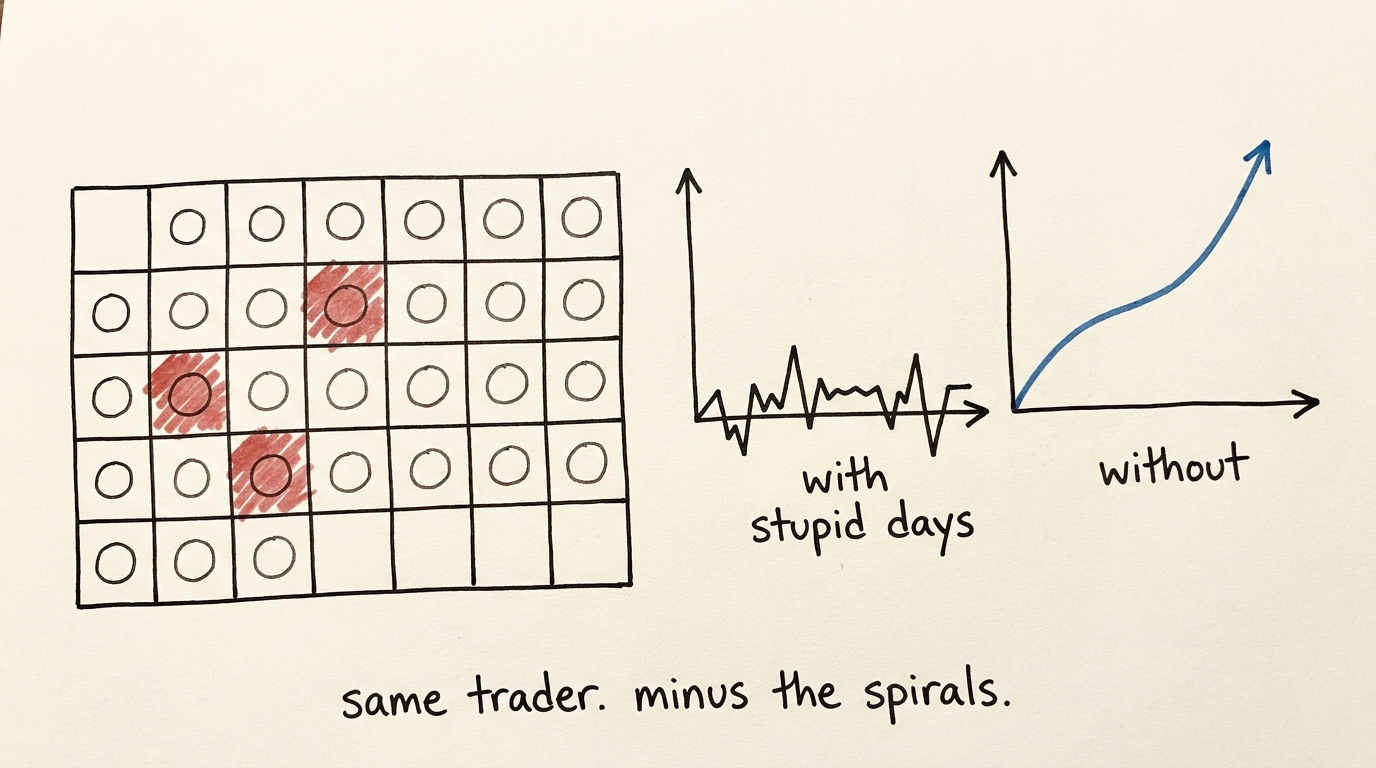
So I ran an exercise on my own records. I erased the stupid days. Not the normal losses. The days where I spiraled out of control, broke my risk limits, all the damage caused by stress. With those days removed, I was a very profitable trader. Over the course of a year, that exercise showed I would have made hundreds of thousands of dollars. At that point in my life, hundreds of thousands of dollars would have changed everything for me and my family. That audit showed me the real constraint. It was never that I was a bad trader. It was that I was so hard on myself that I put myself into a negative mindset where success was impossible. Read that again, because it is probably you too. The perceived problem is "I lack discipline." The actual problem is that after a mistake you run a punishment loop, the punishment loop wrecks your state, and the wrecked state breaks your rules for you. Then you respond to the wreckage by vowing to be even harder on yourself next time, which loads the next spiral. That is beating your head into the wall whenever you fail and telling yourself you are going to do different next time. It is not discipline. It is the loop.
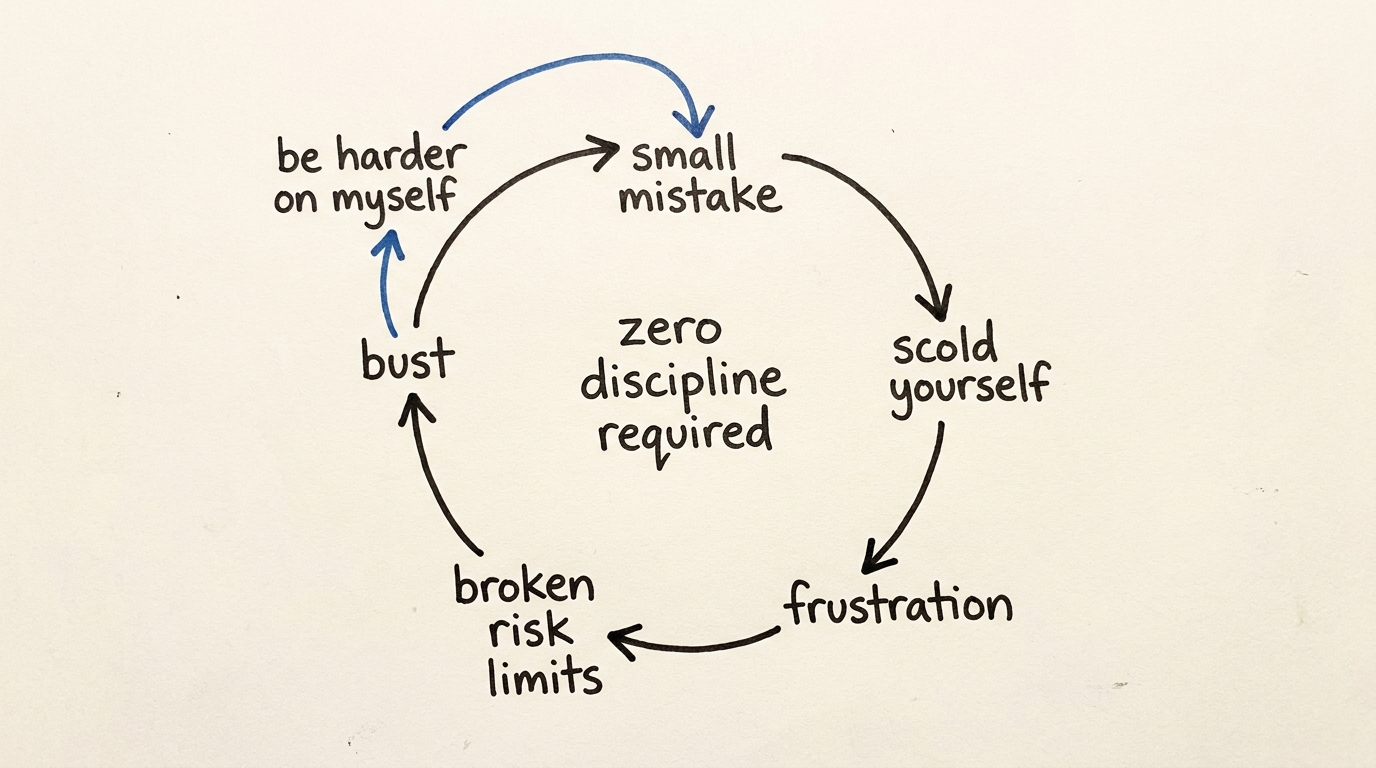
Here is the part nobody says out loud. Self-punishment is not the hard path. It is the easy one. It takes zero discipline to react emotionally and scold yourself. Any losing trader can do it, and nearly all of them do. The hard thing, the thing that takes actual discipline, is holding your frame and staying optimistic when your P&L just gave you a reason not to. Hold yourself accountable for staying optimistic instead of for mistakes. That is the harder standard. You make it farther running toward goals than away from fears.
Why It Works: Your State Is a Rev-Limiter
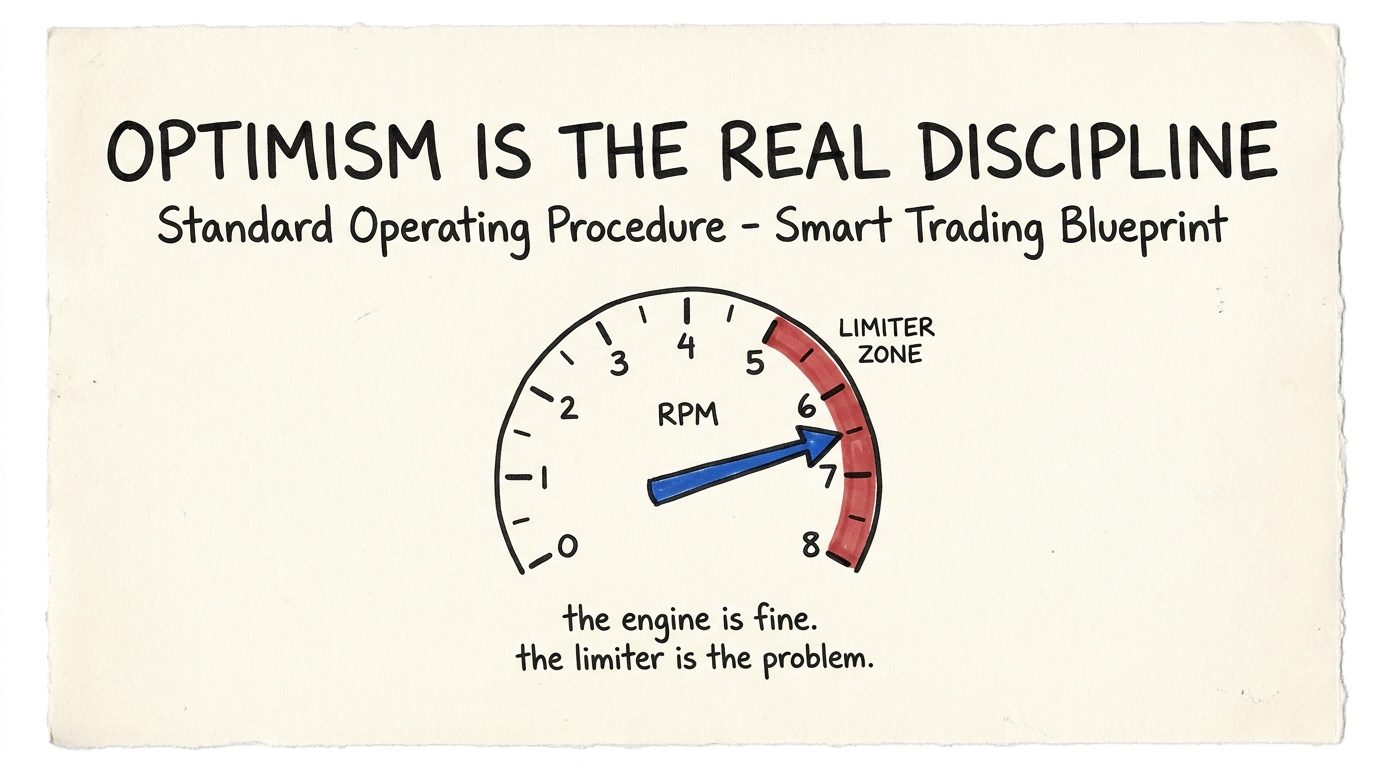
Get the model first, then the process will make sense anywhere you apply it. You could be a Ferrari. Skill, screen time, a real edge. Frustration is a rev-limiter bolted onto that engine. It does not matter what the engine can do if the limiter caps the output. Your state of mind is that limiter. A frustrated, self-attacking trader makes bad decisions, cannot think clearly, stops taking valid risk, and starts trading to avoid pain instead of to make money. That whole cluster is aligned with failure, and no amount of engine upgrades fixes a limiter problem.
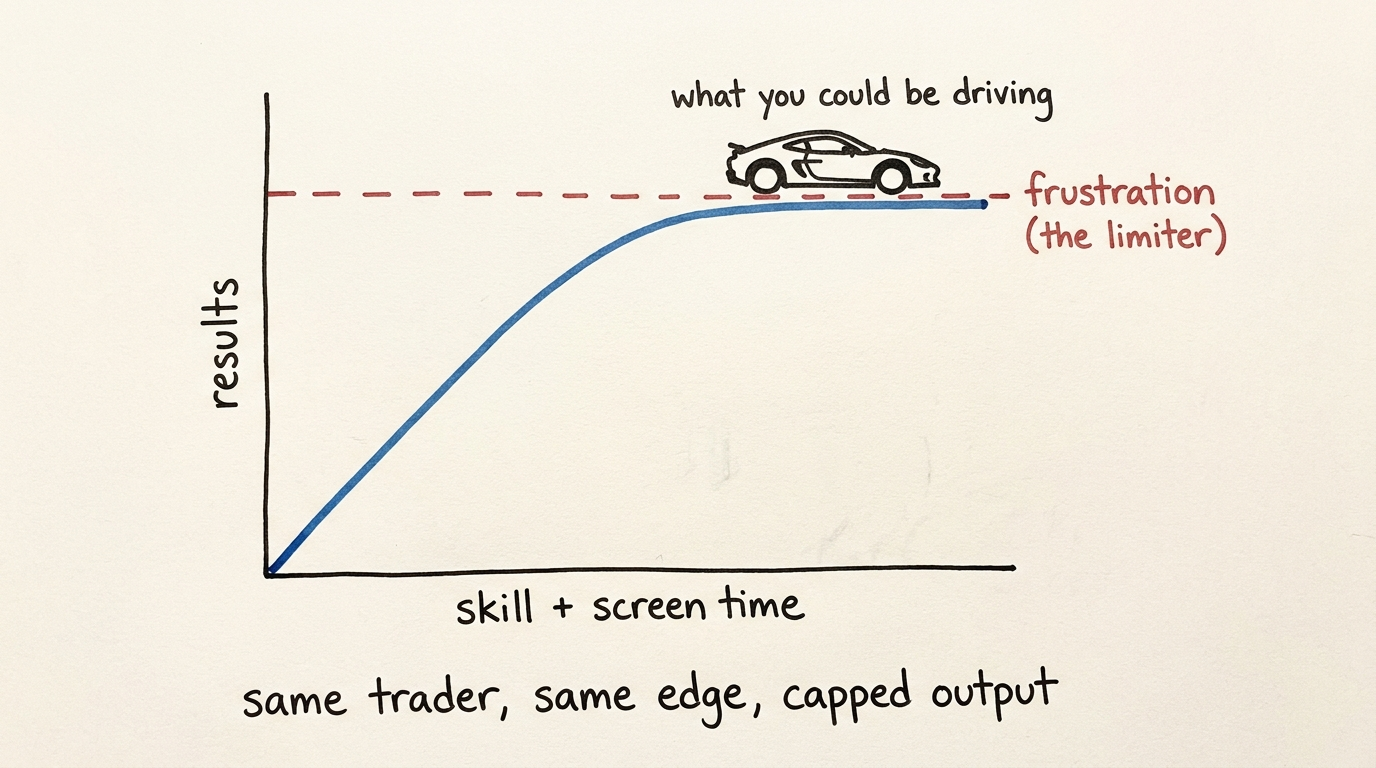
The rev-limiter is not a motivational metaphor. There is real machinery behind it.
The cap is in the head, not the hardware. Sports scientist Tim Noakes built the "central governor" model of exercise: the brain limits muscle output in anticipation of harm, so fatigue is a brain-derived emotion, not a muscle running out of fuel. Performance is capped centrally, below true physical capacity (Noakes, Frontiers in Physiology, 2012). Tim Gallwey, in The Inner Game of Tennis and The Inner Game of Work, wrote the same thing as an equation: performance equals potential minus interference. The engine is fixed in the short run. The only live variable is how much interference you subtract. Frustration distorts your risk perception in the exact wrong direction. In a classic study, fearful people made pessimistic risk judgments and risk-averse choices, while angry people made optimistic risk estimates and risk-seeking choices (Lerner and Keltner, Journal of Personality and Social Psychology, 2001). The angry trader is not disciplined by pain. Anger literally tilts risk perception toward reckless bets. That is revenge trading with a peer-reviewed mechanism. Emotional reactivity costs traders money, measurably. A study of 80 day traders tracked over roughly 25 trading days found that the traders whose emotional reactions to gains and losses were more intense, on both the positive and negative side, performed significantly worse (Lo, Repin, and Steenbarger, American Economic Review, 2005). The limiter is biochemical. Measuring 17 London traders over 8 business days, researchers found morning testosterone ran higher on above-average profit days while cortisol rose with volatility and the variance of returns, and they warned that chronically elevated stress hormones may shift risk preferences and even affect a trader's ability to engage in rational choice (Coates and Herbert, PNAS, 2008). Your stress state is not a mood. It is a governor progressively narrowing your decision envelope.
Now the other half of the model: why the self-punishment strategy specifically fails.
The opposite of scolding is what actually drives correction. Across four experiments, people who responded to a failure with self-compassion, instead of self-criticism or ego-protection, believed the weakness could be changed, were more motivated to make amends, and spent significantly more time studying for a follow-up test after failing the first one (Breines and Chen, Personality and Social Psychology Bulletin, 2012). Being decent to yourself after a mistake is not soft. It is the condition under which humans fix things. The prospective goal-pursuit research points the same way: trait self-criticism predicts less progress, not more, partly through rumination (Powers, Koestner, and Zuroff, 2007). Optimism is a measurable performance variable, not a vibe. Seligman's famous insurance study tracked life insurance agents in a rejection-heavy, commission-based job, about as close to trading as the published research gets. Agents in the optimistic half on explanatory style outsold the pessimistic half by 37 percent over their first two years, and optimists were far more likely to still be employed at all (Seligman and Schulman, Journal of Personality and Social Psychology, 1986). Met Life went on to hire for optimism directly. A whole company held itself accountable for optimism and it showed up in revenue.
Marcus Aurelius put the whole SOP in one line two thousand years ago: "the soul is dyed by the thoughts" (Meditations, Book 5). Mark Douglas said it about trading: "The consistency you seek is in your mind, not in the markets" (Trading in the Zone, 2000).
One clarification before the process. Optimism as discipline does not mean chanting affirmations at your monitor. Repeating "I'm a lovable person" made people with low self-esteem feel worse in controlled studies (Wood, Perunovic, and Lee, Psychological Science, 2009). And it does not mean pretending mistakes did not happen. Aviation runs a "just culture": no blame for honest errors, full accountability for willful violations, because blame suppresses the error-reporting that safety depends on. That is the standard here. Accountability for process and state.
Part II
The Process: Four Plays
The Process: Four Plays
Four plays, run in order. Play 1 proves the problem with your own data. Play 2 converts your worst behavior into specific rules. Play 3 builds the one variable that makes any rule stick. Play 4 makes it permanent.
Play 1: Run the erased-days audit
You do not have to take my word for any of the above, and you should not. Run the exercise that changed my trading on your own records.
Export enough trade history to see your repeated behavior. When I did this I was looking at a year of my trading. Separate your losing days into two piles. Pile one: normal losses. The setup was valid, the risk was planned, it just did not work. Pile two: stupid days. The days you spiraled out of control, broke your risk limits, all the damage caused by stress. Be honest about the sorting. A clean loss is not a stupid day. This is the "resulting" trap Annie Duke names in Thinking in Bets: judging a decision by its outcome. Berating yourself after a bad outcome from a good-process decision trains you to abandon good process. Normal losses stay in your P&L. They are the cost of doing business. Recompute your P&L with only the stupid days erased. Look at the number.
Mine showed hundreds of thousands of dollars over a year. Yours will show whatever it shows. But if erased-days-you is profitable and actual-you is not, you now have proof that your constraint is not skill. It is state.
Pro tip: Poker figured this out before most traders did. Jared Tendler, who wrote The Mental Game of Poker and now coaches traders, defines tilt like this: "Tilt is essentially a more fun way of saying you have a problem with anger in performance." Poker built an entire professional discipline around the fact that the money is lost not in the mistake, but in the emotional state after the mistake. Your erased-days audit is you putting a dollar figure on your own tilt.
Play 2: Quantify your own behavioral probabilities
Play 2 is where I break with almost all trading psychology content. Everybody says "follow your rules." Everybody has heard the behavioral shit a thousand times. Obviously we all know to follow your rules. It does not work, and I am not fully bought into it, because it is vague, and vagueness is killer for traders. When things are vague you do not know if you are doing it right or not, which makes everything more frustrating, which feeds the exact spiral we are trying to kill.
The contrarian move is to stop working on your behavior in general and start quantifying it in particular. You already understand probabilities in your strategy. Now compute the probabilities in your own behavior.
Take your trade data, put it into an AI, and ask questions like:
Where did I start spiraling? At what level of loss do I usually trigger into having my worst days? What do my trades look like in the 30 minutes after a stopped-out trade? Is there a time window of day where I am consistently unprofitable?
Humans are creatures of data. When you have something specific, like "if I lose X amount I have to stop," it is far easier to adhere to than "follow your rules."
For me it was identifying little things like:
If I lose a short and get back into a short within 10 minutes, I almost always lose that trade. There was a specific 15-minute window of the day where I was reliably unprofitable.
Finding these specific things and sticking to them are small wins. You are not chasing profitability immediately. You are learning the probabilities of your own behavior, the same way you learned the probabilities of your strategy, and then adhering to them in small ways. It is stupid not to do that. This is focusing on things you can actually control instead of giving yourself a bunch of theoretical slop about mindset.
Here is a starter prompt. Adjust it to your own data and paste it into any AI along with your trade export:
You are my trading behavior auditor. Do not give me generic trading psychology advice. Work only from my data and my answers.
I am pasting my trade journal / CSV export below. Timestamps matter, keep them.
Two jobs, in order:
JOB 1 - THE ERASED-DAYS AUDIT - Help me identify my "stupid days": days where I broke my risk limits or spiraled, as opposed to normal losing days where risk stayed planned. Ask me what my risk rules are if you need them. - Show me my actual P&L vs my P&L with only the stupid days removed.
JOB 2 - MY BEHAVIORAL PROBABILITIES Answer with specific numbers from my data: 1. Where do I start spiraling? 2. At what level of loss do I usually trigger into having my worst days? Give me a specific threshold. 3. How do my trades perform when I re-enter quickly after a loss? 4. Is there a time window of the day where I am consistently unprofitable?
Then give me the personal rules my data can actually support, each one specific and checkable, in the form "If [exact trigger], then [exact action]," built only from what my data shows. No vague rules. If the data cannot support a rule, say so.
Pro tip: Notice what these personal rules are for. They are not there to make you profitable by themselves. They are tripwires placed exactly where your data says your spirals start. A rule like "no re-shorting within 10 minutes of a losing short" fires at the precise moment the fake-discipline loop used to take the wheel.
Play 3: Build awareness upstream of everything
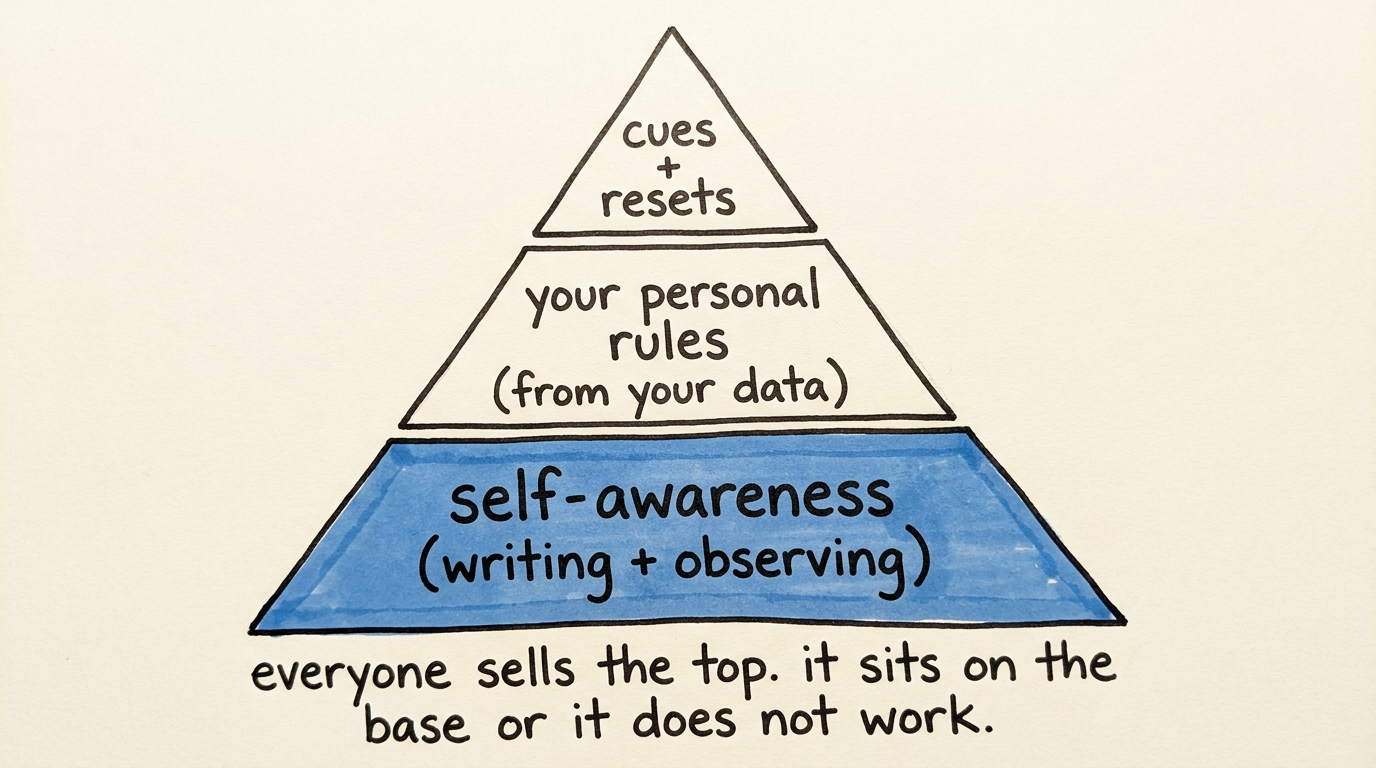
Here is the problem with Play 2, and with every rule, cue, and reset routine you have ever been given.
None of it matters if you do not notice you need it in the moment.
Which brings me to the second place I break with the standard advice. The standard advice is a reset protocol: when you feel tilted, do a breathing exercise, stand up, take a walk. Fine. But this really comes down to how strong your self-awareness is, because you are not going to remember to do any exercise or cue without it. You could do a breathing exercise. You could get up. You could take a walk. It literally does not matter, because the only thing that matters is being able to maintain self-awareness. Cues are interchangeable. Awareness is the upstream variable. No awareness, and the cue never fires.
Even the best case study people point to proves this. After choking in three straight World Cups, the All Blacks brought in mental skills coaches and built the famous "Red Head / Blue Head" system: recognize the tight, anxious state, breathe, then use a personal physical cue to reboot attention. Richie McCaw stamped his feet. Kieran Read looked around the stadium. They won the 2011 and 2015 World Cups. The cues were personal and completely different from player to player. Interchangeable. The trained skill, the part every player shared, was recognizing the state. Awareness first. The cue is downstream.
So how do you train awareness? Two layers, built early and maintained all day.
Layer 1: The morning freewrite. Writing is the only way to truly think. Otherwise thoughts just bounce around, prioritized by emotion. Early in the day, sit down and freewrite. No template, no structure. If you need a starter, begin with one thing you noticed. Then keep writing. You will start to see what is important to you and what has been on your mind. It forces you to put your thoughts down and actually materialize them. You become a thinker. Knowing what your intention was for the day is what gives all-day awareness something to check against, and the page is where it tends to surface.
Do not overthink the format. The anti-vagueness rule from Play 2 applies to behavioral rules, where specificity is everything. Practices are the opposite. Keep them simple and low friction so they actually happen. And there is real evidence under this one too: a meta-analysis of 13 studies of expressive writing in healthy participants found a significant overall benefit, effect size 0.47, across psychological well-being and general functioning (Smyth, Journal of Consulting and Clinical Psychology, 1998). Later analyses found smaller effects in some populations, so treat writing as a thinking and regulation tool, not medicine. That is exactly what we are using it for.
Layer 2: All-day observation. Through the trading day, maintain awareness of the feeling of your body, your posture, and your breathing. Always be trying to observe your thoughts rather than be your thoughts. Most people live on a script where they react to everything all day. The skill is zooming out: how am I feeling right now, and what was my intention for today? That zoom-out is the moment of choice where you can redirect your state instead of being run by it. Gallwey again: "Fighting the mind does not work. What works best is learning to focus it." At the moment of a mistake, this is what awareness is for. Zoom out, notice the heat, and put your attention on what comes next instead of on the autopsy. Coach K institutionalized the same idea at Duke as "Next Play": "Whatever you have done is not nearly as important as what you are doing right now." Review the loss later, in your journal, with your data.
Pro tip: Grade yourself daily on the new standard. Not "did I make money," but "did I hold my state, did I catch my spirals early, and did I stick to the specific rules my data gave me." I started holding myself accountable for thinking better, thinking more clearly, and being more positive, because what did I have to lose? The erased-days audit had already shown me what the old standard cost.
Play 4: Reverse-engineer the identity
The last play is what makes the first three permanent instead of a 30-day phase.
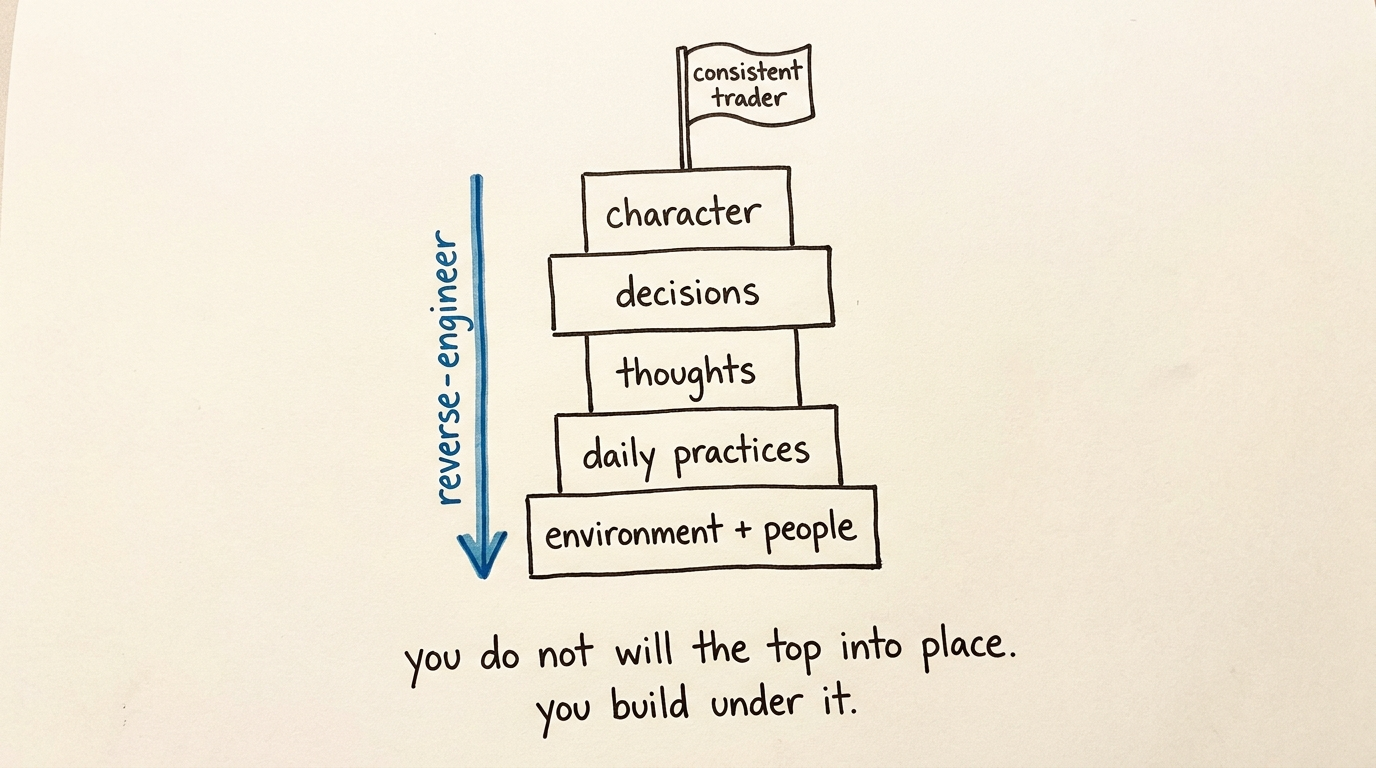
All of this is really building the identity of somebody who is more self-aware, more studious, more stoic. You are not going to read a book and become stoic. But if you read every day, if you have a writing practice, if you meditate, if you go on walks without your phone, if you do the things the version of you who could stay consistent in trading would do, then you become that person.
Who you are, your character, is built up of the decisions you make, micro and macro. And what influences those decisions? Your thoughts, your environment, the people you are around. So you reverse-engineer it, practically and scientifically. Marcus Aurelius said the soul is dyed by its thoughts. These practices are how you pick what it gets dyed with. Pick the daily practices and actually do them, whether or not you feel like it:
The morning freewrite (Play 3, Layer 1). A daily reading practice. Even a few pages. Meditation or deliberate stillness. Any length that actually happens. A phone-free walk. Grading your day on state, not P&L (Play 3's pro tip).
None of these is impressive on its own. That is the point. Doing all these little things is what culminates into the identity. You are not going to get it by wanting it, and you are not going to get it by beating your head into the wall whenever you fail and telling yourself you are going to do different next time. That is the fake-discipline loop from the beginning of this SOP wearing a self-improvement costume. You have to actually change the foundations and the inner workings of who you are.
Part III
Immediate Action Items
Immediate Action Items
Run the erased-days audit this week. Export your trade history, separate normal losses from spiral days, and recompute your P&L without the spirals. Write the two numbers side by side where you can see them. Run the behavioral-probability prompt on your data. Walk away with the specific rules your data supports, like a loss threshold that ends your day, or my no re-shorting within 10 minutes rule. Tomorrow morning, freewrite. Start with one thing you noticed if you need a starter. Keep it loose and keep writing. During the day, run the zoom-out: body, posture, breathing, and observe your thoughts rather than be your thoughts. After a mistake, put your attention on what comes next. Review it after the close. Change what you grade yourself on tonight. Not the P&L. Did you hold your state, did you catch the spiral early, and did you follow the specific rules your data gave you? That is the standard, because it is the harder one. You have been sold the idea that the missing ingredient is suffering, and that the harder you are on yourself the faster you will make it. Your own data will tell you the truth. The engine was never the problem. The limiter was.
Take This Further
This playbook gave you the state-management system. Now let an AI-powered roadmap find the patterns in your own trading data and build the rules your worst days keep proving you need.
Get Your AI Roadmap