
A Smart Trading Blueprint playbook
How to Get Disgustingly Good at Trading (stop studying strategies)
You can't fix what you never see. And you never see what you don't record.
Why do you want another strategy in the first place?
You already have four.
I know why.
Studying feels like progress without risk. Another course, another backtest, another YouTube playlist - it all feels like work, and none of it can lose money today.
It's an unconscious hiding spot for you.
I get it.
Execution exposes you. Studying doesn't. So you keep collecting inputs and calling it preparation.
But the traders who get disgustingly good are not running better strategies. They are running a better feedback loop on themselves. That's what this letter gives you - nine habits I collected over ten years, organized into the loop they actually form.
Trading skill is proprioceptive.
Proprioception sounds like medical jargon, but it stems from the Latin proprius - one's own. Your body's perception of itself.
Close your eyes and touch your nose. You can do it because your body senses its own position without looking.
A drone does the same thing with a gyroscope. It cannot hover without sensing itself.
Here's the problem: as a trader, you have none of this.
Nobody has ever watched you trade. Not your mentor, not your friends, not even you. You have opinions about how you trade. You have zero perception of it.
That exposes the issue nicely.
Every losing trader I've met is trying to fix the market read. The market read was never the problem. The missing sense of self was. So the nine habits below are not tips. They are a nervous system, and each one is a part:
Sensors (perception) - the recording, the emotion notepad, the 30-minute alarm. They read your current state.
Reference (the standard) - the setup grade. It defines what you should be doing.
Comparator (the gap) - the trade breakdown, the samples, the monthly slices. They compute the difference between what you did and what you should have done.
Actuator (the response) - the paired habits. They act on the gap.
The recording creates awareness.
Awareness creates the trigger.
The trigger creates the paired habit.
The habit creates the trader who no longer needs to be watched.
That ladder is the whole letter. Now the habits.
The Playbook
Stop Studying Strategies. Start Studying Yourself.
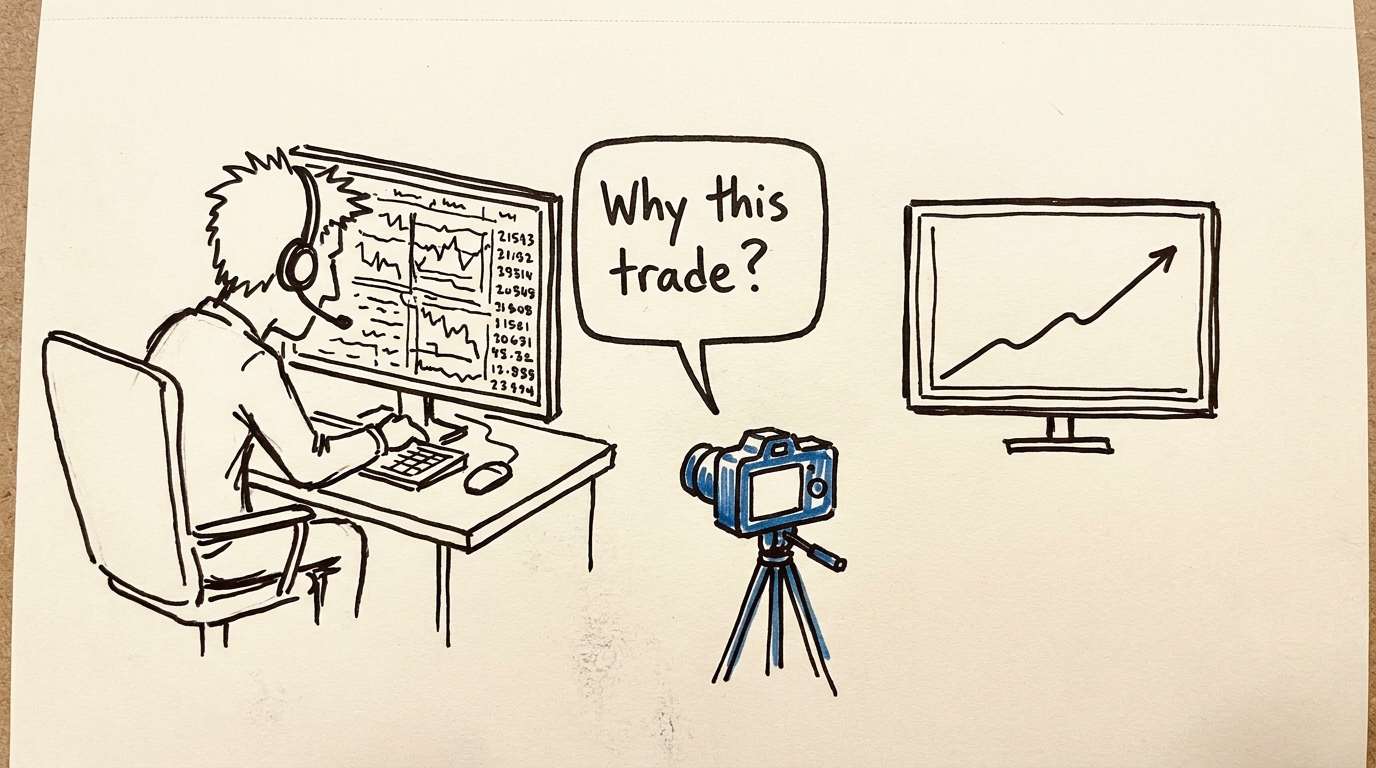
1) Trade on camera (you are the only one who's never seen you trade)
Turn on a screen recording before the session and narrate every decision out loud. Why you entered. Why you didn't.
Then watch it end to end.
It would be stupid to journal your trades from memory - memory smooths over the extra trade, the bigger size, the bad hour. Instead, record the raw tape and let it argue with your memory. The tape wins every time.
I've been doing this publicly since 2022. Most people don't know this, but I came up on social media by live trading - I started recording to document the journey, and it made me a better trader before it ever made me an audience.
Surgeons review tape. Athletes review tape. Traders guess.
The mechanism is forced awareness. When you narrate a decision out loud, you cannot hide from it. Forced awareness is power.
And here is what shocked me most from my own recordings: how much my ideas changed based on nothing but volatility and price movement. Calm tape, one thesis. Fast tape, suddenly another. You will not believe how much the market's mood edits your convictions until you watch yourself get edited.
2) Stop reviewing your trades. Review the trapped.
Most traders review a trade by asking whether the chart went up or down.
Wrong question.
Ask who was wrong, where they were wrong, and what they were forced to do about it.
I used that question on a trade that made $10,475 in fifteen minutes - you can watch me do it live here.
We opened above the previous day's value area high. The value area is the price range where about 70% of the previous day's trading happened, and the value area high is its upper edge. Opening above it gave me bullish context. Price then traded back down into that upper edge, which became the level I wanted to watch.
At that level, aggressive sellers - traders using market orders to sell immediately - pushed into passive buyers. Passive liquidity means limit orders already waiting in the book. Those buyers took every incoming sell order without letting price fall.
That is absorption. One side keeps hitting, the other side absorbs the pressure, and the move stops.
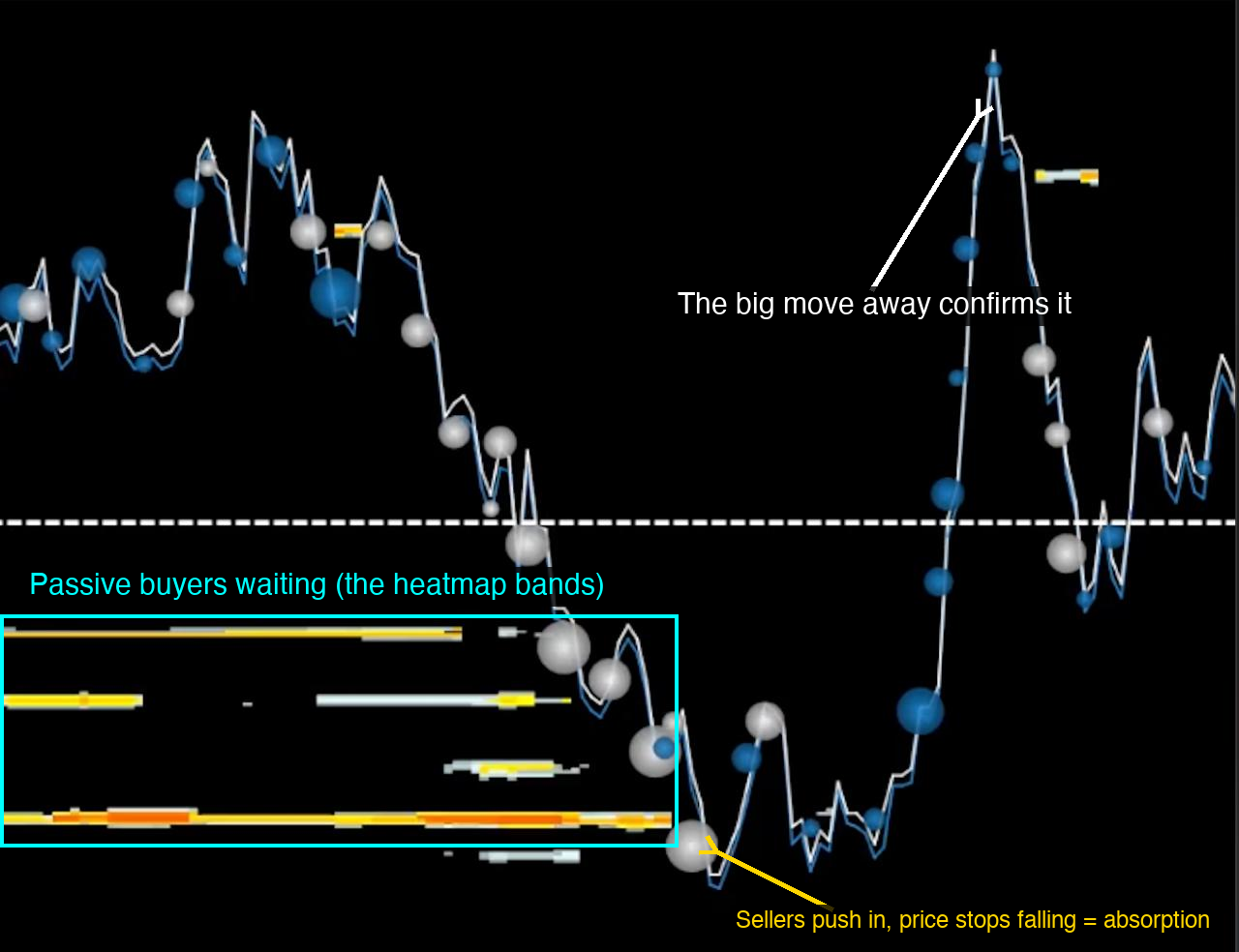
That showed me the trap. Sellers had acted aggressively at a bullish level and could not push through. Until price broke the low, those sellers stayed trapped.
The two captures below show the same trade on a wider view. The solid blue box at the bottom is Deepdom, another way to see passive buyers sitting in size at one level. Same buyers, same story, zoomed out.
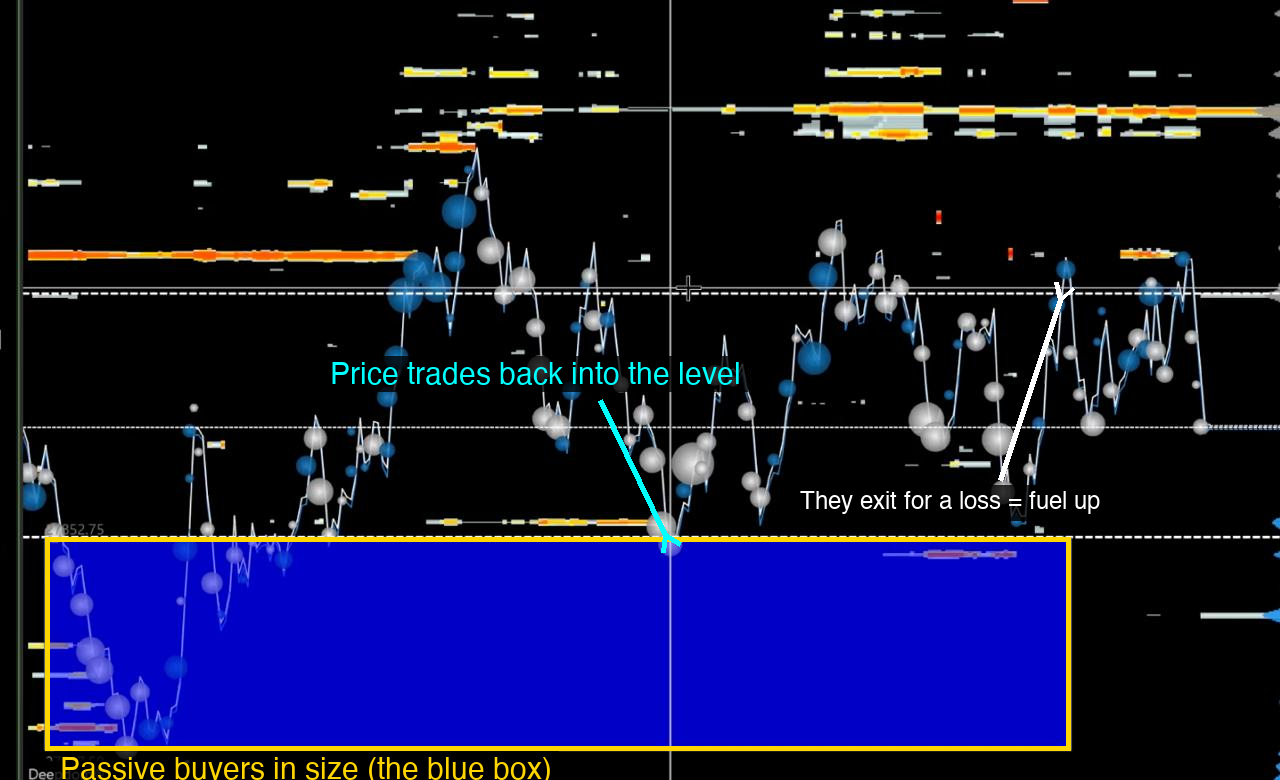
Watch what price does after the first pop. It trades back down into the level. For the trapped sellers, that move down looks like their chance to escape.
It almost never gets all the way back to green for them.
When the other side is in control, the market does not hand trapped traders a profitable exit. So they start exiting for a loss. And here is the part beginners miss: a seller exiting IS a buyer. Every one of those exits adds buying pressure. That wave of forced buying is a big part of what pushes the market up and away.
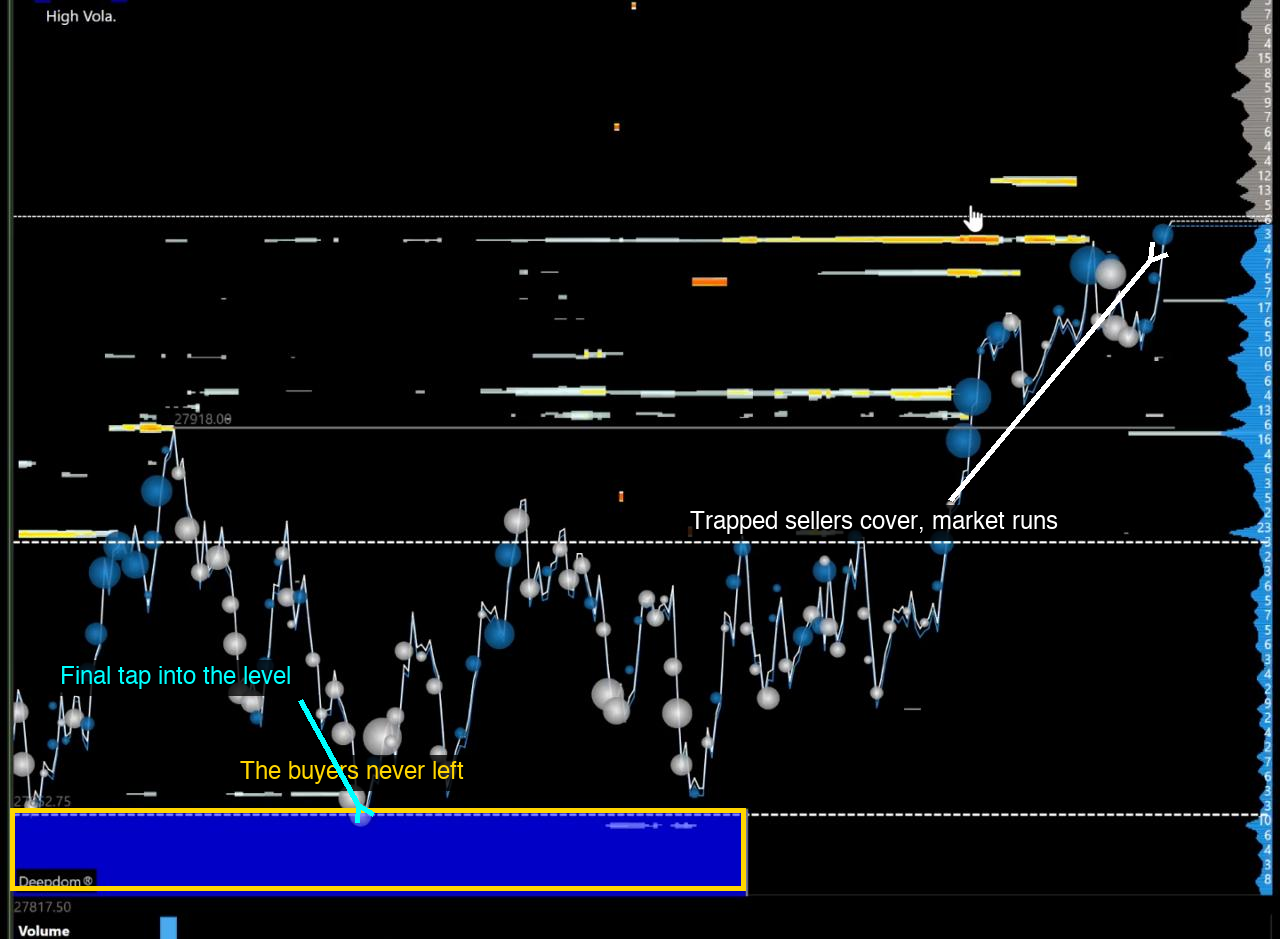
CVD confirmed it - cumulative volume delta, the running difference between aggressive buying and aggressive selling. CVD rose as more aggressive buyers came in. Context, absorption, response, confirmation.
From there I managed the trade by asking the same question again and again: where is the opposition wrong now? Every time sellers tried and failed, their failure created a new place to protect. I trailed my stops behind each one. Not because I was nervous. Because the other side kept proving they were wrong.
Do this breakdown on one trade after every session. Write the condition. Mark the level. Name the trapped group. Mark the price that would free them. Mark every later point where they tried and failed again.
You stop trading candles. You start trading the decisions of the people on the other side of your trade.
3) Set an alarm to check the trader, not the trade
Every 30 minutes: am I calm or worked up? Focused or distracted?
Two questions, on paper, ten seconds.
Your worst trades come from bad states, not bad reads. The alarm creates the pause before the damage.
If you mark worked up or distracted, leave the screen for a few minutes. Come back when you can read your plan without rushing. After a week, check whether your bad states cluster after losses, after wins, or during one part of the session.
The alarm is not telling you whether to buy or sell. It is telling you whether to trust yourself with the next decision.
Forced Awareness, Part Two (delete the P&L column from your journal)
I'll say the uncomfortable part first.
Your emotions are not going away. Not with experience, not with meditation, not with size.
Most traders try to fix the emotion. That's fighting emotion with emotion, and it fails every time.
You can't fight emotion with emotion - you fight emotion with logic. And the skill is not elimination. The skill is speed. How fast you notice you're inside an emotion determines whether logic gets a vote on the next click.
So:
4) Write the feeling down while you're still feeling it
Keep a notepad next to your keyboard. When an emotion shows up, write it down along with what triggered it. Do not talk yourself out of it. Just record it.
On paper, it loses power. Research on affect labeling backs this up: putting feelings into words changes how the brain responds to them. Treat the note as data, not therapy.
And after a week you own something almost nobody has: a list of your actual triggers.
Not trading psychology in general. Yours.
5) Give every trigger a job
This is habit stacking - the Atomic Habits move, applied to the trigger list you just built. When trigger X fires, run response Y. Decided in advance, executed without debate.
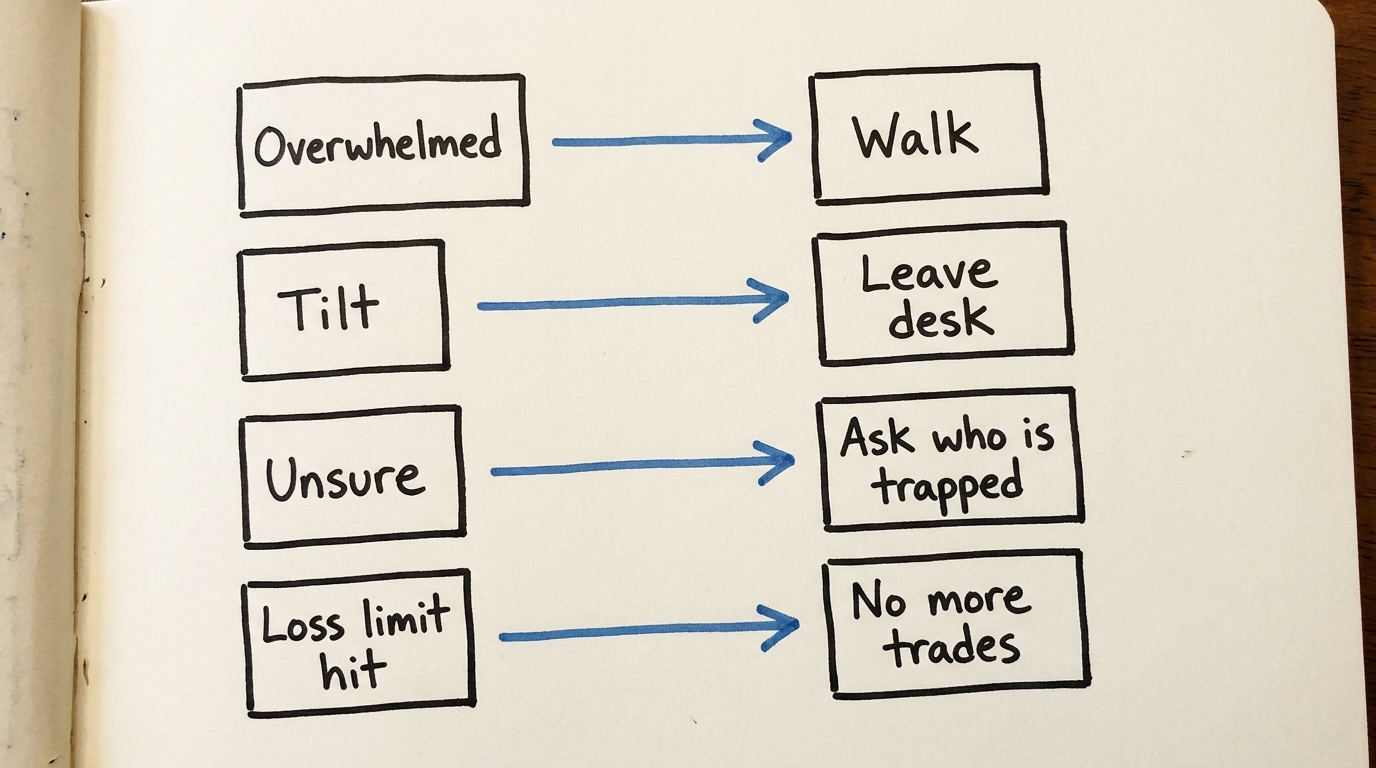
Overwhelmed, go on a walk.
Catch yourself on tilt, leave the desk.
Unsure about a trade, ask where people are trapped.
Loss limit hit, no more trades.
The emotion is the alarm. The habit is the answer. Your triggers will be different from mine - that's the point of the notepad.
6) Let AI read your broker statement (it sees your tilt before you do)
Export your broker data as a CSV. Feed it to AI. Ask three questions:
What patterns show up before my biggest drawdowns?
What happens to my trade frequency after a loss?
What time of day do my losers cluster?
Mine came back with this: if I lose two shorts in a 10-minute period, I'm very likely to lose more money that day.
I could not feel that pattern in real time. The timestamps could.
One rule came out of it - two fast losing shorts and I'm done for the morning - and that single rule paid for every minute of the analysis.
7) Grade every setup before you enter
The size is the grade.
Before entry, I read whether the market is set up for balance, where price rotates, or imbalance, where price expands. I grade that read through value, the gamma environment, and the path ahead. When everything stacks, an A risks 2 to 2.5%. One soft factor makes it a B at 1%. The rare C with bad odds but a huge asymmetric payoff gets 0.5% or less. Below C is no trade.
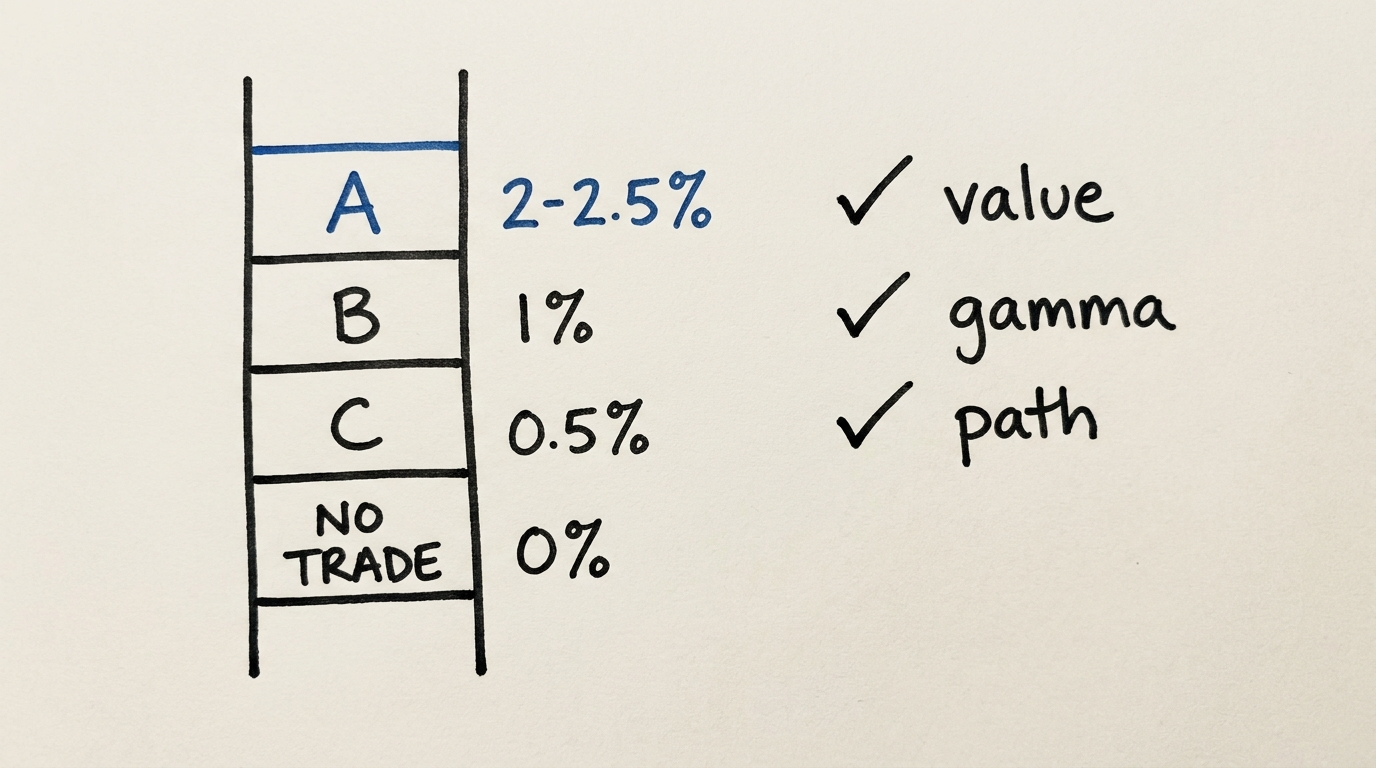
Those percentages apply to your own capital. On a prop account the grade logic carries over exactly, but the dollar risk anchors to your remaining drawdown buffer, and that math works differently. I wrote a full SOP on exactly how I size - read it after this one.
The habit is smaller than the system: never let a feeling pick your size. The grade picks. You just obey it.
8) Grade the empty minutes too
The time between trades is still trading.
Give yourself three allowed modes: reviewing, researching, or recovering. Reviewing means updating levels or checking whether the condition changed. Researching means studying a planned idea. Recovering means leaving the screen long enough to reset.
Staring at candles until boredom forces a trade is not a fourth mode.
At the close, grade your downtime A to F. Track that grade next to the day's P&L for 20 sessions and look for the association. If your bad days keep sitting next to D and F downtime, the fix is not another entry pattern. It is a better plan for the empty minutes.
9) Pull samples, not opinions
Big news day? Don't start with what you think the news should mean.
Define the event precisely - the exact release, surprise, or percentage move that qualifies. Pull every instance like it from the last twenty years. Count the sample. Measure what happened over the next five days and the next thirty.
Most samples will not hand you a trade. That is useful too. When a pattern does stand out, write it as a hypothesis with the sample size attached. Only then open the chart.
Then turn the same lens on yourself. Slice your month three ways - by setup, by time of day, by size. One trader found he only blew up after losing in the first hour. He could not feel that pattern in real time. The cuts showed it to him, and the answer was one rule: after an opening loss, take a break before the next trade.
(This letter is itself the method working - every habit in it came out of recordings, notepads, and broker exports I kept before I knew what they'd teach me.)
Pick one habit. Run it for a week. Then add the next.
The loop builds the trader.
Smart Trading Blueprint provides education only. It is not financial, investment, or tax advice. Trading carries substantial risk of loss. Results vary and are not guaranteed.
Take This Further
You have the nine moves. Now get an AI-personalized roadmap that tells you which one to run first based on your own trading data.
Get Your AI Roadmap